Intemporal artigo do Warren Buffet onde salienta com recurso a evidência empírica como é possível, recorrendo à estrutura de análise e avaliação de activos defendida por Graham e Dodd no seu livro Security Analysis de 1934. O investimento em valor recorrendo a métodos de análise perfeitamente identificados e muito divuldados aliados a uma estrutural mental correspondente produz, numa série de exemplos enunciados por Buffet, retornos bastante razoáveis acima da média do mercado, recorrendo, na maior parte das vezes a ideias de investimento diferentes. No entanto, em todos estes Superinvestidores a ideia fundamental de investimento mantém-se: comprar activos subavaliados em relação ao seu valor intrínseco, salvaguardados por uma margem de segurança e independentemente das condições de mercado.
De realçar igualmente a crítica directa aos modelos téoricos de mercados eficientes (risco tem a ver com a o desconto ou prémio a que se compra um activo em relação ao seu valor intrínseco e não a volatilidade do mesmo) e a modelos de análise de variações e volumes (análise técnica).
Pode consultar o artigo aqui.
segunda-feira, outubro 30, 2006


sexta-feira, setembro 08, 2006
"Stocks For The Long Run" (1994) by Jeremy Siegel
A professor at the Wharton School of Business, Jeremy Siegel makes the case for - you guessed it - investing in stocks over the long run. He draws on extensive research over the past two centuries to argue not only that equities surpass all other financial assets when it comes to returns, but also that stock returns are safer and more predictable in the face of the effects of inflation.


sexta-feira, agosto 11, 2006
Lynch & Buffett: What's In Your Wallets?
Lynch & Buffett: What's In Your Wallets?
John P. Reese, Validea Hot List 08.11.06, 6:00 AM ET
Capital One Financial has some funny advertisements (at least some people think they're funny), such as those with comedian David Spade. But there's no joking about how this financial institution is growing and making money.
Recently, I wrote in this column about the strategies I use based on Warren Buffett's and Peter Lynch's approaches to investing. These are both great strategies, and they both think that Capital One is laughing all the way to the bank.
What is Capital One (nyse: COF - news - people )? It was a major issuer of credit cards and still is. It used to focus on sub-prime borrowers, but refocused a few years back and now attracts better-quality customers. Yet again, however, it is redirecting itself by entering the banking business. Just last year, it purchased Louisiana's Hibernia National Bank and is currently completing the purchase of New York's North Fork Bancorp. (nyse: NFB - news - people ). The advantages of owning banks are that they bring in relatively cheap deposits and diversify the company's revenue base.
Upon completion of the North Fork acquisition, Capital One should be among the ten largest banking companies in the country. Also, it recently posted earnings that disappointed Wall Street and knocked more than 10% off the stock's market value.
This setup means that in Capital One we have a strong company and a stock that seems unjustly discounted--its price-to-earnings ratio is only ten. For these reasons alone, Capital One is worthy of your consideration. And, of course, two proven guru strategies conclude that Capital One is worth buying.
Warren Buffett Strategy
The Buffett strategy likes companies with a competitive advantage, such as being among the largest or best known in their industry. Capital One is about to become one of the ten largest banking companies in the country, and it already has strong brand recognition; it has a Buffett-type franchise.
Another plus is that its earnings have been predictable, rising every year for the last ten years. Return on equity should be north of 15%, and Capital One's return on equity is 19.7%. Another plus is its return on assets, which needs to be at least 1%; in Capital One's case, ROA has averaged 2.5% over the past ten years.
A measure of management's ability to perform for the benefit of shareholders is how well management invested the company's retained earnings. Over the past ten years, retained earnings at Capital One have totaled $30.62, while earnings per share have jumped $5.96, which earned for shareholders a 19.5% return on the earnings kept.
This is during a period in which an index ETF such as the S&P Depositary Receipts (amex: SPY - news - people ) has struggled to produce low single-digit percentage gains on an annualized basis. Nice work, Capital One.
All of this analysis suggests that Capital One is performing well from a financial point of view. But the Buffett strategy wants the stock also to be well priced. The Buffett strategy uses two methods to analyze price, and they agree that at current prices Capital One shareholders can expect a rate of return somewhere between 13.8% and 19%, or 16.4% on average. This is very strong.
Bottom line: The company is performing well financially, and its stock is nicely priced. It's a Buffett-style buy.
Peter Lynch Strategy
The screen based on Peter Lynch's strategy also thinks Capital One is a born moneymaker. One very compelling criterion is its price-to-earnings-growth ratio, or PEG (P/E relative to growth). This should be 1.0 or less, and anything south of 0.5 is very strong. Capital One's PEG is a very strong 0.46. Note, its P/E is a weak 10.41, while its growth rate (based on the average of the three-, four- and five-year historical EPS growth rates) is 22.5%.
Also noteworthy is its equity-to-assets ratio. The Lynch strategy wants this to be at least 5%, while Capital One's is a robust 18%. Plus, its return on assets is a compelling 3% (1% is the minimum). If you loved Lynch at Fidelity Magellan (FMAGX), you could buy some Capital One to emulate the investing style of this master.
Capital One has a track record of success. It is diversifying into banking, which has its pluses. The stock is now trading at friendly levels. And the guru strategies are banking on it
John P. Reese is founder and CEO of Validea.com and Validea Capital Management. He is also co-author of The Market Gurus: Stock Investing Strategies You Can Use From Wall Street's Best . Click here for more of Reese's insights and analysis, and to learn about subscribing to the Validea Hot List. At the time of publication, John Reese and his clients owned shares of Capital One Financial.
in http://www.forbes.com/2006/08/10/capitalone-buffett-lynch-in_jr_0810guruscreen_inl.html?partner=yahootix
John P. Reese, Validea Hot List 08.11.06, 6:00 AM ET
Capital One Financial has some funny advertisements (at least some people think they're funny), such as those with comedian David Spade. But there's no joking about how this financial institution is growing and making money.
Recently, I wrote in this column about the strategies I use based on Warren Buffett's and Peter Lynch's approaches to investing. These are both great strategies, and they both think that Capital One is laughing all the way to the bank.
What is Capital One (nyse: COF - news - people )? It was a major issuer of credit cards and still is. It used to focus on sub-prime borrowers, but refocused a few years back and now attracts better-quality customers. Yet again, however, it is redirecting itself by entering the banking business. Just last year, it purchased Louisiana's Hibernia National Bank and is currently completing the purchase of New York's North Fork Bancorp. (nyse: NFB - news - people ). The advantages of owning banks are that they bring in relatively cheap deposits and diversify the company's revenue base.
Upon completion of the North Fork acquisition, Capital One should be among the ten largest banking companies in the country. Also, it recently posted earnings that disappointed Wall Street and knocked more than 10% off the stock's market value.
This setup means that in Capital One we have a strong company and a stock that seems unjustly discounted--its price-to-earnings ratio is only ten. For these reasons alone, Capital One is worthy of your consideration. And, of course, two proven guru strategies conclude that Capital One is worth buying.
Warren Buffett Strategy
The Buffett strategy likes companies with a competitive advantage, such as being among the largest or best known in their industry. Capital One is about to become one of the ten largest banking companies in the country, and it already has strong brand recognition; it has a Buffett-type franchise.
Another plus is that its earnings have been predictable, rising every year for the last ten years. Return on equity should be north of 15%, and Capital One's return on equity is 19.7%. Another plus is its return on assets, which needs to be at least 1%; in Capital One's case, ROA has averaged 2.5% over the past ten years.
A measure of management's ability to perform for the benefit of shareholders is how well management invested the company's retained earnings. Over the past ten years, retained earnings at Capital One have totaled $30.62, while earnings per share have jumped $5.96, which earned for shareholders a 19.5% return on the earnings kept.
This is during a period in which an index ETF such as the S&P Depositary Receipts (amex: SPY - news - people ) has struggled to produce low single-digit percentage gains on an annualized basis. Nice work, Capital One.
All of this analysis suggests that Capital One is performing well from a financial point of view. But the Buffett strategy wants the stock also to be well priced. The Buffett strategy uses two methods to analyze price, and they agree that at current prices Capital One shareholders can expect a rate of return somewhere between 13.8% and 19%, or 16.4% on average. This is very strong.
Bottom line: The company is performing well financially, and its stock is nicely priced. It's a Buffett-style buy.
Peter Lynch Strategy
The screen based on Peter Lynch's strategy also thinks Capital One is a born moneymaker. One very compelling criterion is its price-to-earnings-growth ratio, or PEG (P/E relative to growth). This should be 1.0 or less, and anything south of 0.5 is very strong. Capital One's PEG is a very strong 0.46. Note, its P/E is a weak 10.41, while its growth rate (based on the average of the three-, four- and five-year historical EPS growth rates) is 22.5%.
Also noteworthy is its equity-to-assets ratio. The Lynch strategy wants this to be at least 5%, while Capital One's is a robust 18%. Plus, its return on assets is a compelling 3% (1% is the minimum). If you loved Lynch at Fidelity Magellan (FMAGX), you could buy some Capital One to emulate the investing style of this master.
Capital One has a track record of success. It is diversifying into banking, which has its pluses. The stock is now trading at friendly levels. And the guru strategies are banking on it
John P. Reese is founder and CEO of Validea.com and Validea Capital Management. He is also co-author of The Market Gurus: Stock Investing Strategies You Can Use From Wall Street's Best . Click here for more of Reese's insights and analysis, and to learn about subscribing to the Validea Hot List. At the time of publication, John Reese and his clients owned shares of Capital One Financial.
in http://www.forbes.com/2006/08/10/capitalone-buffett-lynch-in_jr_0810guruscreen_inl.html?partner=yahootix
segunda-feira, julho 03, 2006
Martin Zweig's 3 rules for picking stocks
Martin Zweig's 3 rules for picking stocks made him a legend. A similar system might make you money, too.
By Harry Domash
Unless you've been in the stock market for some time, you've probably never heard of Martin Zweig. Whether you have or not, I'm about to explain why it's a name worth remembering.
Almost two years ago, I wrote an article with a stock-selection screen based on Zweig's strategies. The screen, run Aug. 11, 2004, turned up 17 stocks (excluding one that had already agreed to be acquired). Last week I checked on the performance of that portfolio.
Let's take a trip back in time. After its first year (as of Aug. 11, 2005), the portfolio had recorded an impressive 40% average return, compared to 15% for the S&P 500 ($INX). But the story is even better than it sounds. Often, even though recording strong average returns, such portfolios usually include a few hefty losers. But, in this case, only two stocks dropped, with the biggest loss totaling only 11%.
After the first year, the portfolio lost steam. As of June 23, it had averaged a 43% return since its August 2004 inception, vs. 16% for the S&P 500. While the average return is still impressive, the results were more volatile, with bigger winners and more weak performers.
Given those results, the Zweig screen rates another look. But first, some background on Martin Zweig.
Although no longer in the limelight, Zweig, who has a Ph.D. in finance, is well known to market professionals for his disciplined approach to the market. His now-discontinued Zweig Forecast newsletter was ranked No. 1 for risk-adjusted returns over the 15 years that it was tracked by Hulbert Financial Digest.
He has examined the relationship between stock-market action and just about every conceivable economic or market indicator. In fact, he's credited with inventing the put-call ratio market sentiment indicator.
Zweig described the results of much of his research in his best-selling book, "Martin Zweig's Winning on Wall Street," which is still in print. Much of the book covers Zweig's market-timing indicators, but he also details his stock selection strategies.
It's all in the numbers
When it comes to picking stocks, Zweig is strictly a numbers guy. As he put it, "If a company can show nice consistent earnings, I don't care if it makes broomsticks or computer parts." Zweig focuses on three main criteria to pinpoint potential winners:
- Strong historical sales and earnings growth.
- A reasonable price.
- Strong price action relative to the market.
Zweig avoids stocks that have recently disappointed the market, and he doesn't like firms carrying high debt. While he doesn't want to overpay, Zweig is willing to pay more for strong stocks. Says Zweig, "buying on strength gives you an edge. You must pay a premium, but you increase the probability of being right." I'll fill in the details as I describe my screen for finding stocks meeting Zweig's criteria. (Click here to go to MSN Money's Stock Screener.)
I'll start with sales and earnings growth, which are Zweig's top priorities.
Long-term growth
Zweig wants to see consistent sales and earnings growth, going back four or five years. He considers 15% annual earnings growth acceptable, but prefers more. In his book, he gives numerous examples of stocks with 30% to 50% historical growth rates.
I require at least 15% average annual sales and earnings-per-share growth, measured over the past five years. Try increasing the minimums for either or both to 20% or even 25%, if you get too many hits.
Screening parameter: (5-year) Annual EPS Growth Rate >= 15%
Screening parameter: 5-Year Revenue Growth >= 15%
Recent growth
Zweig avoids stocks with decelerating growth rates. He wants to see the most recent quarter's year-over-year EPS growth rate in the same ballpark as the long-term rate and, ideally, higher. However, he's not dogmatic and is willing to cut a stock a little slack, depending on conditions.
I require the most recent quarter's year-over-year EPS growth to be at least 75% of the long-term growth rate.
Screening Parameter: EPS Growth Qtr vs. Qtr >= 0.75* (5-year) Annual EPS Growth
The "depending on conditions" aspect requires a judgment call that you can't emulate in a screen. In my first Zweig article, I suggested "further checking" if the last quarter's EPS growth was near the 75% minimum.
To minimize that ambiguity, this time I'm also requiring that the most-recent quarter's year-over-year revenue growth be at least 85% of the long-term revenue growth rate. I figure that the problem is temporary if earnings stumble but revenue growth remains reasonably on track.
Screening Parameter: Revenue Growth Qtr vs. Qtr >= 0.85* (5-year) Annual Revenue Growth.
Revenues keep pace
Ideally, earnings growth should track revenue growth. Revenues growing faster than earnings reflect declining profit margins, which signals that market conditions are becoming more competitive. Conversely, earnings growing faster than revenues says that the growth is coming from cost cutting rather than growing sales. If that's the case, eventually, the company will run out of places to cut costs, and earnings growth will slow.
So, while they won't track precisely, Zweig wants to see stocks with revenue and EPS long-term growth rates in the same ballpark. To emulate that condition, I require that long-term revenue must be at least 75% of earnings, and vice-versa.
Screening Parameter: (5-year) Annual EPS Growth Rate >= 0. 75*5-Year Revenue Growth
Screening Parameter: 5-Year Revenue Growth .+ 0.75*(5-year) Annual EPS Growth Rate
Don't overpay
Zweig doesn't want to overpay for stocks. He uses price-to-earnings ratios to measure valuation, but he doesn't set a hard-and-fast limit. Instead, his definition of overvalued depends on the market. In the examples in his book, Zweig accepts fast-growing companies with P/Es as much as 50% higher than the overall market.
I use the S&P 500 average P/E to represent the market, and reject stocks trading with P/Es more than 50% above the S&P.
Screening Parameter: P/E Ratio: Current <= 1.5*S&P 500 Average P/E Ratio: Current Don't underpay
As much as he doesn't want to overpay, Zweig also avoids stocks that are too cheap. For him, very low P/Es signal that investors are abandoning ship, probably for good reason.
In his book, Zweig advised shunning stocks with P/Es below 5. Since his maximum P/E varies with the market, I used the same approach for defining "too cheap." When he wrote the book, a P/E of 5 equated to roughly 40% of the market average, so I set my minimum P/E at that level.
Screening Parameter: P/E Ratio: Current >= 0.4*S&P 500 Average P/E Ratio Current
Pick winners
Zweig said he prefers stocks that are outperforming the market, although he will accept stocks "acting at least as well as the market."
Relative strength measures a stock's performance compared with the overall market over a specified timeframe. Zweig didn't mention a timeframe, but from his descriptions, I guessed that six months was in the ballpark. A 50 relative strength indicates a stock performing even with the market. Try increasing the minimum to 55 or 60 if you get too many hits.
Screening Parameter: 6-month Relative Strength>=50
Bad debt
Zweig said he prefers to avoid high-debt firms, but he wasn't specific. The debt-equity ratio, which is long-term debt divided by shareholders' equity, is the most-commonly used debt measure. Zero values signal no long-term debt, and the higher the ratio, the higher the debt.
Since Zweig was vague in his definition of high debt, and acceptable debt levels vary by industry, I rule out companies with debt-equity ratios higher than their industry average.
Screening Parameter: Debt to Equity Ratio <= Industry Average Debt to Equity Ratio Don't be surprised
Zweig avoided stocks that had recently disappointed the market by reporting earnings below forecasts. So, I rule out stocks with recent negative earnings surprises.
Screening parameter: Recent Qtr Surprise %>=0
Zweig also said he prefers stocks with some insider buying, or, at least minimal insider selling. In my original screen, I disqualified stocks where insider selling exceeded insider buying. However, I found that option exercises and related selling distorted the insider data. So, this time, I'm eliminating that requirement.
My screen turned up 15 stocks, with four of them in the energy sector. There was also an overweighting of regional banks, with two stocks in that category. Risk-averse investors should avoid duplicating stocks in the same industries. One of the stocks, Nicholas Financial (NICK, news, msgs), was in my original screen from August 2004.
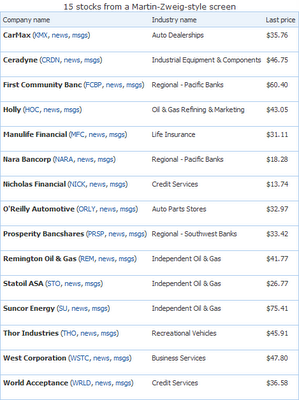
Zweig advises selling a stock if it drops roughly 15% below the purchase price. Otherwise, plan on holding these stocks for one year and then selling.
in http://articles.moneycentral.msn.com/Investing/SimpleStrategies/
MasterStrategistsSystemPicks15Gems.aspx?page=2
By Harry Domash
Unless you've been in the stock market for some time, you've probably never heard of Martin Zweig. Whether you have or not, I'm about to explain why it's a name worth remembering.
Almost two years ago, I wrote an article with a stock-selection screen based on Zweig's strategies. The screen, run Aug. 11, 2004, turned up 17 stocks (excluding one that had already agreed to be acquired). Last week I checked on the performance of that portfolio.
Let's take a trip back in time. After its first year (as of Aug. 11, 2005), the portfolio had recorded an impressive 40% average return, compared to 15% for the S&P 500 ($INX). But the story is even better than it sounds. Often, even though recording strong average returns, such portfolios usually include a few hefty losers. But, in this case, only two stocks dropped, with the biggest loss totaling only 11%.
After the first year, the portfolio lost steam. As of June 23, it had averaged a 43% return since its August 2004 inception, vs. 16% for the S&P 500. While the average return is still impressive, the results were more volatile, with bigger winners and more weak performers.
Given those results, the Zweig screen rates another look. But first, some background on Martin Zweig.
Although no longer in the limelight, Zweig, who has a Ph.D. in finance, is well known to market professionals for his disciplined approach to the market. His now-discontinued Zweig Forecast newsletter was ranked No. 1 for risk-adjusted returns over the 15 years that it was tracked by Hulbert Financial Digest.
He has examined the relationship between stock-market action and just about every conceivable economic or market indicator. In fact, he's credited with inventing the put-call ratio market sentiment indicator.
Zweig described the results of much of his research in his best-selling book, "Martin Zweig's Winning on Wall Street," which is still in print. Much of the book covers Zweig's market-timing indicators, but he also details his stock selection strategies.
It's all in the numbers
When it comes to picking stocks, Zweig is strictly a numbers guy. As he put it, "If a company can show nice consistent earnings, I don't care if it makes broomsticks or computer parts." Zweig focuses on three main criteria to pinpoint potential winners:
- Strong historical sales and earnings growth.
- A reasonable price.
- Strong price action relative to the market.
Zweig avoids stocks that have recently disappointed the market, and he doesn't like firms carrying high debt. While he doesn't want to overpay, Zweig is willing to pay more for strong stocks. Says Zweig, "buying on strength gives you an edge. You must pay a premium, but you increase the probability of being right." I'll fill in the details as I describe my screen for finding stocks meeting Zweig's criteria. (Click here to go to MSN Money's Stock Screener.)
I'll start with sales and earnings growth, which are Zweig's top priorities.
Long-term growth
Zweig wants to see consistent sales and earnings growth, going back four or five years. He considers 15% annual earnings growth acceptable, but prefers more. In his book, he gives numerous examples of stocks with 30% to 50% historical growth rates.
I require at least 15% average annual sales and earnings-per-share growth, measured over the past five years. Try increasing the minimums for either or both to 20% or even 25%, if you get too many hits.
Screening parameter: (5-year) Annual EPS Growth Rate >= 15%
Screening parameter: 5-Year Revenue Growth >= 15%
Recent growth
Zweig avoids stocks with decelerating growth rates. He wants to see the most recent quarter's year-over-year EPS growth rate in the same ballpark as the long-term rate and, ideally, higher. However, he's not dogmatic and is willing to cut a stock a little slack, depending on conditions.
I require the most recent quarter's year-over-year EPS growth to be at least 75% of the long-term growth rate.
Screening Parameter: EPS Growth Qtr vs. Qtr >= 0.75* (5-year) Annual EPS Growth
The "depending on conditions" aspect requires a judgment call that you can't emulate in a screen. In my first Zweig article, I suggested "further checking" if the last quarter's EPS growth was near the 75% minimum.
To minimize that ambiguity, this time I'm also requiring that the most-recent quarter's year-over-year revenue growth be at least 85% of the long-term revenue growth rate. I figure that the problem is temporary if earnings stumble but revenue growth remains reasonably on track.
Screening Parameter: Revenue Growth Qtr vs. Qtr >= 0.85* (5-year) Annual Revenue Growth.
Revenues keep pace
Ideally, earnings growth should track revenue growth. Revenues growing faster than earnings reflect declining profit margins, which signals that market conditions are becoming more competitive. Conversely, earnings growing faster than revenues says that the growth is coming from cost cutting rather than growing sales. If that's the case, eventually, the company will run out of places to cut costs, and earnings growth will slow.
So, while they won't track precisely, Zweig wants to see stocks with revenue and EPS long-term growth rates in the same ballpark. To emulate that condition, I require that long-term revenue must be at least 75% of earnings, and vice-versa.
Screening Parameter: (5-year) Annual EPS Growth Rate >= 0. 75*5-Year Revenue Growth
Screening Parameter: 5-Year Revenue Growth .+ 0.75*(5-year) Annual EPS Growth Rate
Don't overpay
Zweig doesn't want to overpay for stocks. He uses price-to-earnings ratios to measure valuation, but he doesn't set a hard-and-fast limit. Instead, his definition of overvalued depends on the market. In the examples in his book, Zweig accepts fast-growing companies with P/Es as much as 50% higher than the overall market.
I use the S&P 500 average P/E to represent the market, and reject stocks trading with P/Es more than 50% above the S&P.
Screening Parameter: P/E Ratio: Current <= 1.5*S&P 500 Average P/E Ratio: Current Don't underpay
As much as he doesn't want to overpay, Zweig also avoids stocks that are too cheap. For him, very low P/Es signal that investors are abandoning ship, probably for good reason.
In his book, Zweig advised shunning stocks with P/Es below 5. Since his maximum P/E varies with the market, I used the same approach for defining "too cheap." When he wrote the book, a P/E of 5 equated to roughly 40% of the market average, so I set my minimum P/E at that level.
Screening Parameter: P/E Ratio: Current >= 0.4*S&P 500 Average P/E Ratio Current
Pick winners
Zweig said he prefers stocks that are outperforming the market, although he will accept stocks "acting at least as well as the market."
Relative strength measures a stock's performance compared with the overall market over a specified timeframe. Zweig didn't mention a timeframe, but from his descriptions, I guessed that six months was in the ballpark. A 50 relative strength indicates a stock performing even with the market. Try increasing the minimum to 55 or 60 if you get too many hits.
Screening Parameter: 6-month Relative Strength>=50
Bad debt
Zweig said he prefers to avoid high-debt firms, but he wasn't specific. The debt-equity ratio, which is long-term debt divided by shareholders' equity, is the most-commonly used debt measure. Zero values signal no long-term debt, and the higher the ratio, the higher the debt.
Since Zweig was vague in his definition of high debt, and acceptable debt levels vary by industry, I rule out companies with debt-equity ratios higher than their industry average.
Screening Parameter: Debt to Equity Ratio <= Industry Average Debt to Equity Ratio Don't be surprised
Zweig avoided stocks that had recently disappointed the market by reporting earnings below forecasts. So, I rule out stocks with recent negative earnings surprises.
Screening parameter: Recent Qtr Surprise %>=0
Zweig also said he prefers stocks with some insider buying, or, at least minimal insider selling. In my original screen, I disqualified stocks where insider selling exceeded insider buying. However, I found that option exercises and related selling distorted the insider data. So, this time, I'm eliminating that requirement.
My screen turned up 15 stocks, with four of them in the energy sector. There was also an overweighting of regional banks, with two stocks in that category. Risk-averse investors should avoid duplicating stocks in the same industries. One of the stocks, Nicholas Financial (NICK, news, msgs), was in my original screen from August 2004.
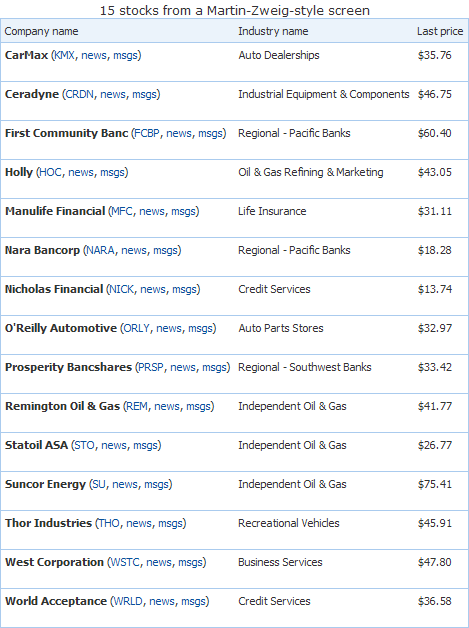
Zweig advises selling a stock if it drops roughly 15% below the purchase price. Otherwise, plan on holding these stocks for one year and then selling.
in http://articles.moneycentral.msn.com/Investing/SimpleStrategies/
MasterStrategistsSystemPicks15Gems.aspx?page=2
terça-feira, junho 20, 2006
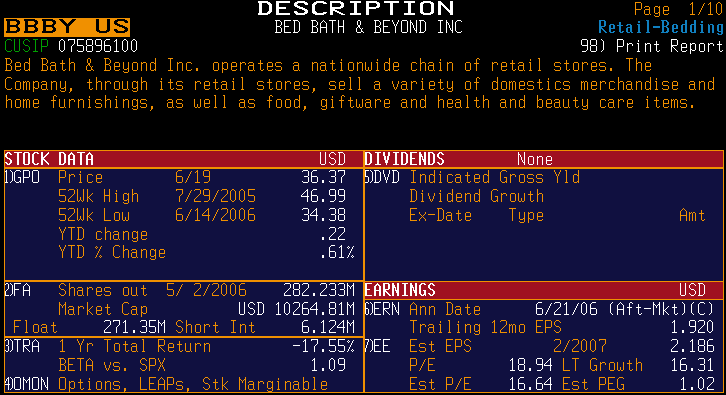
Análise Bed Bath & Beyond
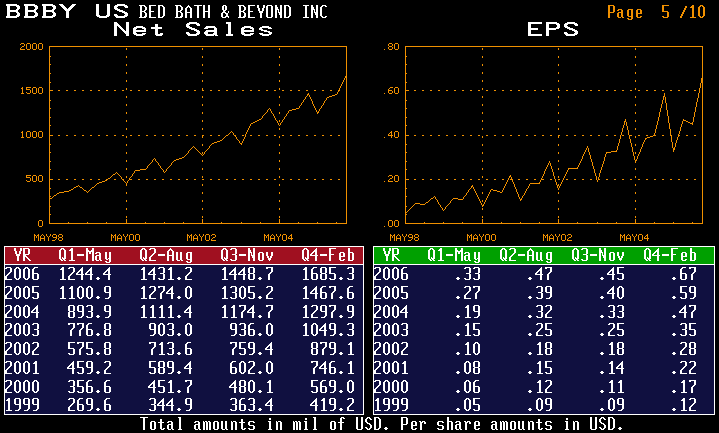
Poucas empresas detêm um track record de crescimento de resultados e rentabilidades tão consistentes: Média crescimento de resultados = 30%/anos nos últimos 10 anos com uma média de retornos no capital próprio de 26.81%.
O negócio é a venda a retalho de mobília, merchandise doméstico, produtos de beleza e saúde, etc... A empresa é superiormente gerida e bastante competitiva, geradora de fortes cash-flows. A dívida de longo prazo é zero. O potencial de abertura de lojas é grande e a expansão para outros conceitos de loja também. As estimativas de resultados apontam para um crescimento nos próximos 5 anos na ordem dos 15%. O retorno ao accionista através de programas de recompra de acções é também bastante apetecível, para além do sinal de confiança que a administração transmite ao mercado. Um abrandamento no mercado imobiliário pode eventualmente abrandar o crescimento das vendas.
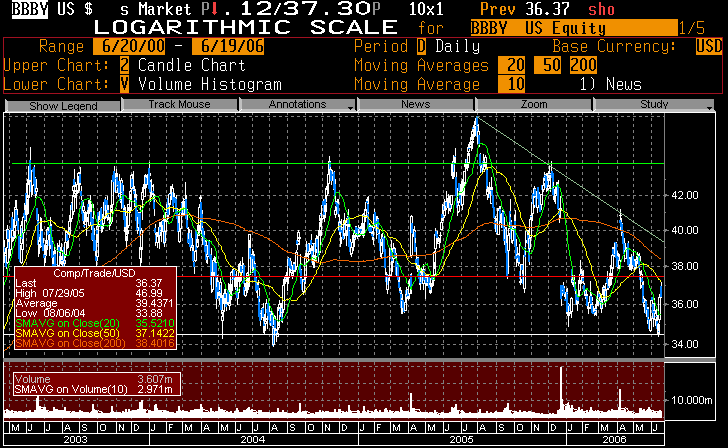
Já sigo esta empresa à dois anos. Mas só entraria neste negócio de eleição ao preço certo. Julgo a zona de entrada que transmitiria uma margem de segurança suficiente será abaixo dos 35$.
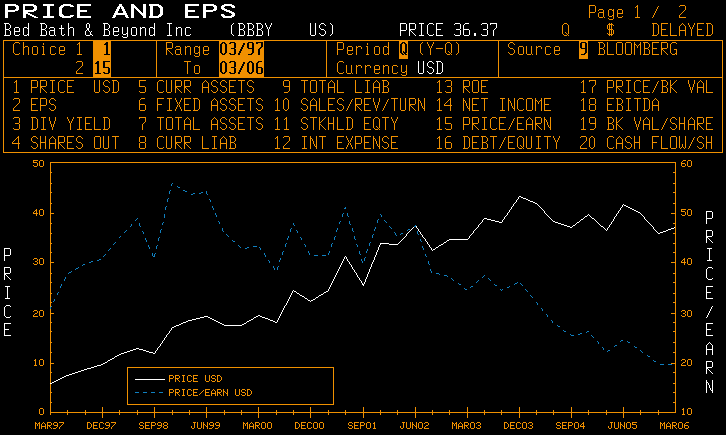
A acção encontração com múltiplos em mínimos históricos e a cotação em cima do suporte dos 35$.
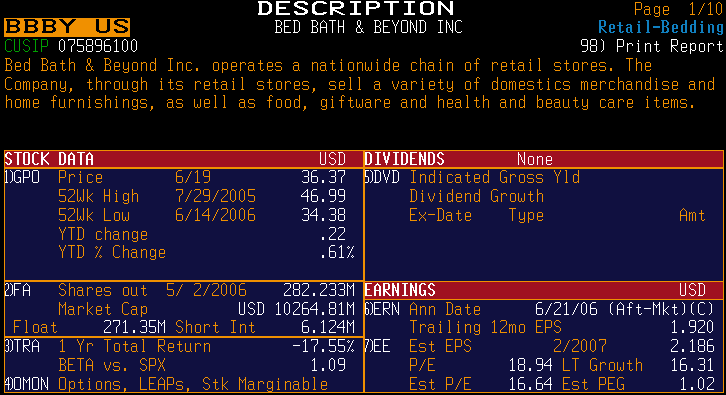
Ficam alguns dados descritivos do negócio bem como um gráfico com a correspondente análise técnica.
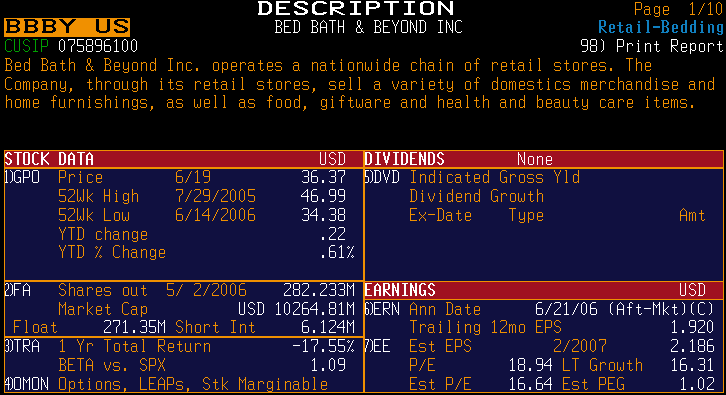


O negócio é a venda a retalho de mobília, merchandise doméstico, produtos de beleza e saúde, etc... A empresa é superiormente gerida e bastante competitiva, geradora de fortes cash-flows. A dívida de longo prazo é zero. O potencial de abertura de lojas é grande e a expansão para outros conceitos de loja também. As estimativas de resultados apontam para um crescimento nos próximos 5 anos na ordem dos 15%. O retorno ao accionista através de programas de recompra de acções é também bastante apetecível, para além do sinal de confiança que a administração transmite ao mercado. Um abrandamento no mercado imobiliário pode eventualmente abrandar o crescimento das vendas.
Já sigo esta empresa à dois anos. Mas só entraria neste negócio de eleição ao preço certo. Julgo a zona de entrada que transmitiria uma margem de segurança suficiente será abaixo dos 35$.
A acção encontração com múltiplos em mínimos históricos e a cotação em cima do suporte dos 35$.
Ficam alguns dados descritivos do negócio bem como um gráfico com a correspondente análise técnica.
sexta-feira, junho 16, 2006
Good to Great: Why Some Companies Make the Leap... and Others Don't
Um excelente livro sobre as qualidades intrínsecas que os grandes negócios possuem que os conduzem à excelência. A qualidade da administração, o foco no seu core business, a comunicação com o mercado ou as relações entre colaboradores, são alguns factores que Jim Collins encontrou para justificar o desempenho espectacular de 11 empresas que deram o salto.
Este é um trabalho pertinente para quem procura avaliar as qualidades subjectivas de um determinado negócio para além dos números dos relatórios financeiros na linha do que Phil Fisher fazia e como bem explicou em Common Stocks and Uncommon Profits and Other Writings.
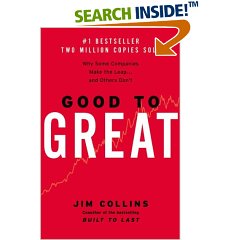
Amazon.com's Best of 2001Five years ago, Jim Collins asked the question, "Can a good company become a great company and if so, how?" In Good to Great Collins, the author of Built to Last, concludes that it is possible, but finds there are no silver bullets. Collins and his team of researchers began their quest by sorting through a list of 1,435 companies, looking for those that made substantial improvements in their performance over time. They finally settled on 11--including Fannie Mae, Gillette, Walgreens, and Wells Fargo--and discovered common traits that challenged many of the conventional notions of corporate success. Making the transition from good to great doesn't require a high-profile CEO, the latest technology, innovative change management, or even a fine-tuned business strategy. At the heart of those rare and truly great companies was a corporate culture that rigorously found and promoted disciplined people to think and act in a disciplined manner. Peppered with dozens of stories and examples from the great and not so great, the book offers a well-reasoned road map to excellence that any organization would do well to consider. Like Built to Last, Good to Great is one of those books that managers and CEOs will be reading and rereading for years to come.
Harry C. Edwards
http://www.amazon.com/gp/product/0066620996/sr=8-1/qid=1150478367/ref=pd_bbs_1/104-7298190-0727155?%5Fencoding=UTF8
Este é um trabalho pertinente para quem procura avaliar as qualidades subjectivas de um determinado negócio para além dos números dos relatórios financeiros na linha do que Phil Fisher fazia e como bem explicou em Common Stocks and Uncommon Profits and Other Writings.

Amazon.com's Best of 2001Five years ago, Jim Collins asked the question, "Can a good company become a great company and if so, how?" In Good to Great Collins, the author of Built to Last, concludes that it is possible, but finds there are no silver bullets. Collins and his team of researchers began their quest by sorting through a list of 1,435 companies, looking for those that made substantial improvements in their performance over time. They finally settled on 11--including Fannie Mae, Gillette, Walgreens, and Wells Fargo--and discovered common traits that challenged many of the conventional notions of corporate success. Making the transition from good to great doesn't require a high-profile CEO, the latest technology, innovative change management, or even a fine-tuned business strategy. At the heart of those rare and truly great companies was a corporate culture that rigorously found and promoted disciplined people to think and act in a disciplined manner. Peppered with dozens of stories and examples from the great and not so great, the book offers a well-reasoned road map to excellence that any organization would do well to consider. Like Built to Last, Good to Great is one of those books that managers and CEOs will be reading and rereading for years to come.
Harry C. Edwards
http://www.amazon.com/gp/product/0066620996/sr=8-1/qid=1150478367/ref=pd_bbs_1/104-7298190-0727155?%5Fencoding=UTF8
quarta-feira, abril 26, 2006
Looking For Hidden Value With Whitney Tilson
By Emma Trincal
Staff Reporter
4/25/2006 11:42 AM EDT
URL: http://www.thestreet.com/markets/hedgefunds/10281104.html
Staff Reporter
4/25/2006 11:42 AM EDT
URL: http://www.thestreet.com/markets/hedgefunds/10281104.html
Subscrever:
Mensagens (Atom)