Primeira parte de uma entrevista de Warren Buffet a Liz Claman da CNBC. Foi um programa de 45 minutos onde nos é dado a conhecer um pouco melhor o segundo homem mais rico do mundo (ou terceiro), a sua personalidade, o seu método de investimento, o seu estilo de vida...
sábado, abril 28, 2007


quarta-feira, abril 25, 2007
A Maestro of Investments in the Style of Buffett
By GERALDINE FABRIKANT
Published: April 23, 2007
CHICAGO — Warren E. Buffett is hardly a man of mystery.
But when investors gather in Omaha in two weeks for the Berkshire Hathaway annual meeting, there will be a nagging question mark over the head of the 76-year-old chairman: who might someday replace him in each of the two roles he plays — chief executive of Berkshire Hathaway, and its chief investment officer?
A bit more is known about the choice of a future chief executive. Mr. Buffett has said there are three candidates from various Berkshire-owned companies. Buffett watchers speculate that the list includes David L. Sokol of MidAmerican Energy Holdings; Ajit Jain, head of the reinsurance division of Berkshire’s National Indemnity Company; Tony Nicely, chief executive of Geico; Joseph P. Brandon, chairman of General Re; and Richard T. Santulli, founder of NetJets.
The bigger mystery is who will become the chief investment officer. Mr. Buffett says he does not know himself. On this point of succession, “frankly, we are not as well prepared,” he wrote in his 2006 shareholder letter last month.
Here is a clue, though. He or she will probably be a lot like Louis Simpson.
... http://www.nytimes.com/2007/04/23/business/23simpson.html?_r=3&pagewanted=1&ref=business&oref=slogin
Published: April 23, 2007
CHICAGO — Warren E. Buffett is hardly a man of mystery.
But when investors gather in Omaha in two weeks for the Berkshire Hathaway annual meeting, there will be a nagging question mark over the head of the 76-year-old chairman: who might someday replace him in each of the two roles he plays — chief executive of Berkshire Hathaway, and its chief investment officer?
A bit more is known about the choice of a future chief executive. Mr. Buffett has said there are three candidates from various Berkshire-owned companies. Buffett watchers speculate that the list includes David L. Sokol of MidAmerican Energy Holdings; Ajit Jain, head of the reinsurance division of Berkshire’s National Indemnity Company; Tony Nicely, chief executive of Geico; Joseph P. Brandon, chairman of General Re; and Richard T. Santulli, founder of NetJets.
The bigger mystery is who will become the chief investment officer. Mr. Buffett says he does not know himself. On this point of succession, “frankly, we are not as well prepared,” he wrote in his 2006 shareholder letter last month.
Here is a clue, though. He or she will probably be a lot like Louis Simpson.
... http://www.nytimes.com/2007/04/23/business/23simpson.html?_r=3&pagewanted=1&ref=business&oref=slogin
quarta-feira, novembro 22, 2006
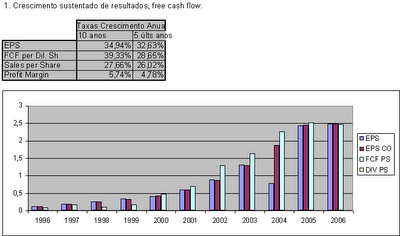
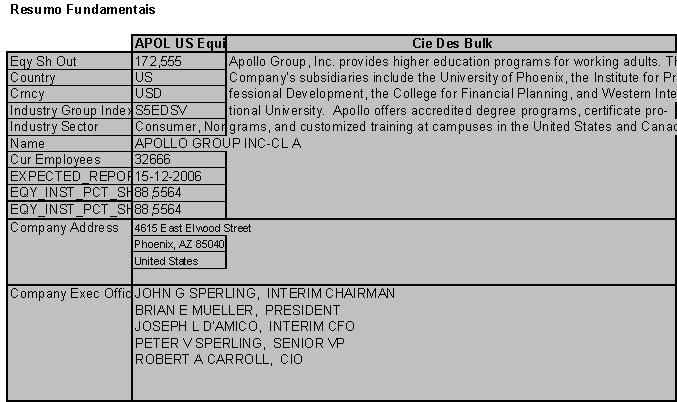
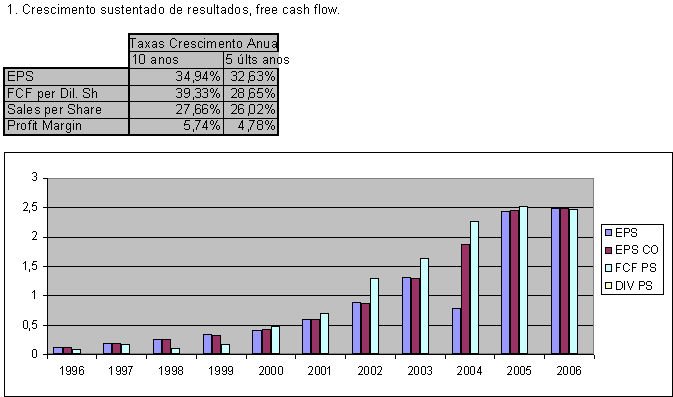
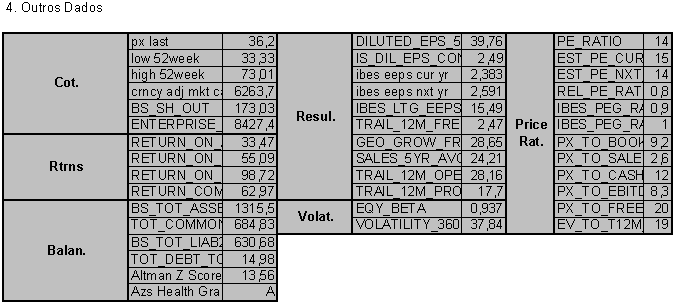
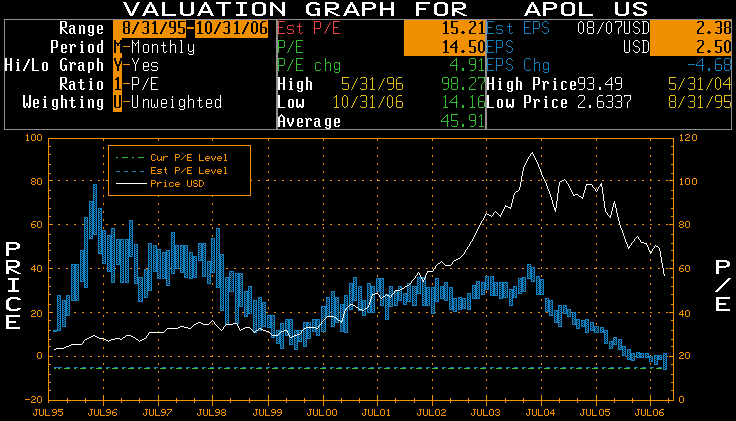
Análise Apollo Group (APOL)
Os mercados estão em máximos mas ainda há valor a excelentes preços. A Apollo Group gere universidades nos Estados Unidos e possui um negócio de ensino Online. Com uma dívida reduzida e um historial de rentabilidades impressionante e revelador do elevado potencial deste sector de actividade protegido por decretos estatais que lhe atribuem qualidades de monopólio nas regiões onde estão presentes, a Apollo está a cotar na sua avaliação mínima de sempre. A 14 vezes os resultados estimados para o próximo ano, é sem dúvida uma excelente compra...




When Genius Failed: The Rise and Fall of Long-Term Capital Management
História fantástica e muito bem relatada por Roger Lowenstein sobre a queda do Hedge Fund Long Term Capital Management. Fundado em 94 por John Meriwether, contava no Conselho da Administração com dois prémios nobel de 97: Myron Sholes e Robert. C. Merton. Com um capital próprio inicial de cerca de 1 bilião de dólares, teve uma performance extraordinária até aos inícios de 98 quando valia 4.6 biliões. Tudo perdido em menos de 4 meses.
A Teoria dos Mercados Eficientes colocada em prática e levada ao extremo!
A ideia de que todo o risco é controlável!
O problema dos pressupostos teóricos que condicionam invariávelmente as conclusões!
Os instrumentos derivados e a alavancagem como armas de destruição financeira maciça!
Uma história incrível, que ilustra exemplarmente como a ideia de certeza nos mercados financeiros pode conduzir a estragos consideráveis.
Serão os mercados eficientes?
"The market can stay irrational longer than you can stay solvent."
John Maynard Keynes
A Teoria dos Mercados Eficientes colocada em prática e levada ao extremo!
A ideia de que todo o risco é controlável!
O problema dos pressupostos teóricos que condicionam invariávelmente as conclusões!
Os instrumentos derivados e a alavancagem como armas de destruição financeira maciça!
Uma história incrível, que ilustra exemplarmente como a ideia de certeza nos mercados financeiros pode conduzir a estragos consideráveis.
Serão os mercados eficientes?
"The market can stay irrational longer than you can stay solvent."
John Maynard Keynes

segunda-feira, outubro 30, 2006
The Superinvestors of Graham-and-Doddsville
Intemporal artigo do Warren Buffet onde salienta com recurso a evidência empírica como é possível, recorrendo à estrutura de análise e avaliação de activos defendida por Graham e Dodd no seu livro Security Analysis de 1934. O investimento em valor recorrendo a métodos de análise perfeitamente identificados e muito divuldados aliados a uma estrutural mental correspondente produz, numa série de exemplos enunciados por Buffet, retornos bastante razoáveis acima da média do mercado, recorrendo, na maior parte das vezes a ideias de investimento diferentes. No entanto, em todos estes Superinvestidores a ideia fundamental de investimento mantém-se: comprar activos subavaliados em relação ao seu valor intrínseco, salvaguardados por uma margem de segurança e independentemente das condições de mercado.
De realçar igualmente a crítica directa aos modelos téoricos de mercados eficientes (risco tem a ver com a o desconto ou prémio a que se compra um activo em relação ao seu valor intrínseco e não a volatilidade do mesmo) e a modelos de análise de variações e volumes (análise técnica).
Pode consultar o artigo aqui.
De realçar igualmente a crítica directa aos modelos téoricos de mercados eficientes (risco tem a ver com a o desconto ou prémio a que se compra um activo em relação ao seu valor intrínseco e não a volatilidade do mesmo) e a modelos de análise de variações e volumes (análise técnica).
Pode consultar o artigo aqui.
sexta-feira, setembro 08, 2006
"Stocks For The Long Run" (1994) by Jeremy Siegel
A professor at the Wharton School of Business, Jeremy Siegel makes the case for - you guessed it - investing in stocks over the long run. He draws on extensive research over the past two centuries to argue not only that equities surpass all other financial assets when it comes to returns, but also that stock returns are safer and more predictable in the face of the effects of inflation.


sexta-feira, agosto 11, 2006
Lynch & Buffett: What's In Your Wallets?
Lynch & Buffett: What's In Your Wallets?
John P. Reese, Validea Hot List 08.11.06, 6:00 AM ET
Capital One Financial has some funny advertisements (at least some people think they're funny), such as those with comedian David Spade. But there's no joking about how this financial institution is growing and making money.
Recently, I wrote in this column about the strategies I use based on Warren Buffett's and Peter Lynch's approaches to investing. These are both great strategies, and they both think that Capital One is laughing all the way to the bank.
What is Capital One (nyse: COF - news - people )? It was a major issuer of credit cards and still is. It used to focus on sub-prime borrowers, but refocused a few years back and now attracts better-quality customers. Yet again, however, it is redirecting itself by entering the banking business. Just last year, it purchased Louisiana's Hibernia National Bank and is currently completing the purchase of New York's North Fork Bancorp. (nyse: NFB - news - people ). The advantages of owning banks are that they bring in relatively cheap deposits and diversify the company's revenue base.
Upon completion of the North Fork acquisition, Capital One should be among the ten largest banking companies in the country. Also, it recently posted earnings that disappointed Wall Street and knocked more than 10% off the stock's market value.
This setup means that in Capital One we have a strong company and a stock that seems unjustly discounted--its price-to-earnings ratio is only ten. For these reasons alone, Capital One is worthy of your consideration. And, of course, two proven guru strategies conclude that Capital One is worth buying.
Warren Buffett Strategy
The Buffett strategy likes companies with a competitive advantage, such as being among the largest or best known in their industry. Capital One is about to become one of the ten largest banking companies in the country, and it already has strong brand recognition; it has a Buffett-type franchise.
Another plus is that its earnings have been predictable, rising every year for the last ten years. Return on equity should be north of 15%, and Capital One's return on equity is 19.7%. Another plus is its return on assets, which needs to be at least 1%; in Capital One's case, ROA has averaged 2.5% over the past ten years.
A measure of management's ability to perform for the benefit of shareholders is how well management invested the company's retained earnings. Over the past ten years, retained earnings at Capital One have totaled $30.62, while earnings per share have jumped $5.96, which earned for shareholders a 19.5% return on the earnings kept.
This is during a period in which an index ETF such as the S&P Depositary Receipts (amex: SPY - news - people ) has struggled to produce low single-digit percentage gains on an annualized basis. Nice work, Capital One.
All of this analysis suggests that Capital One is performing well from a financial point of view. But the Buffett strategy wants the stock also to be well priced. The Buffett strategy uses two methods to analyze price, and they agree that at current prices Capital One shareholders can expect a rate of return somewhere between 13.8% and 19%, or 16.4% on average. This is very strong.
Bottom line: The company is performing well financially, and its stock is nicely priced. It's a Buffett-style buy.
Peter Lynch Strategy
The screen based on Peter Lynch's strategy also thinks Capital One is a born moneymaker. One very compelling criterion is its price-to-earnings-growth ratio, or PEG (P/E relative to growth). This should be 1.0 or less, and anything south of 0.5 is very strong. Capital One's PEG is a very strong 0.46. Note, its P/E is a weak 10.41, while its growth rate (based on the average of the three-, four- and five-year historical EPS growth rates) is 22.5%.
Also noteworthy is its equity-to-assets ratio. The Lynch strategy wants this to be at least 5%, while Capital One's is a robust 18%. Plus, its return on assets is a compelling 3% (1% is the minimum). If you loved Lynch at Fidelity Magellan (FMAGX), you could buy some Capital One to emulate the investing style of this master.
Capital One has a track record of success. It is diversifying into banking, which has its pluses. The stock is now trading at friendly levels. And the guru strategies are banking on it
John P. Reese is founder and CEO of Validea.com and Validea Capital Management. He is also co-author of The Market Gurus: Stock Investing Strategies You Can Use From Wall Street's Best . Click here for more of Reese's insights and analysis, and to learn about subscribing to the Validea Hot List. At the time of publication, John Reese and his clients owned shares of Capital One Financial.
in http://www.forbes.com/2006/08/10/capitalone-buffett-lynch-in_jr_0810guruscreen_inl.html?partner=yahootix
John P. Reese, Validea Hot List 08.11.06, 6:00 AM ET
Capital One Financial has some funny advertisements (at least some people think they're funny), such as those with comedian David Spade. But there's no joking about how this financial institution is growing and making money.
Recently, I wrote in this column about the strategies I use based on Warren Buffett's and Peter Lynch's approaches to investing. These are both great strategies, and they both think that Capital One is laughing all the way to the bank.
What is Capital One (nyse: COF - news - people )? It was a major issuer of credit cards and still is. It used to focus on sub-prime borrowers, but refocused a few years back and now attracts better-quality customers. Yet again, however, it is redirecting itself by entering the banking business. Just last year, it purchased Louisiana's Hibernia National Bank and is currently completing the purchase of New York's North Fork Bancorp. (nyse: NFB - news - people ). The advantages of owning banks are that they bring in relatively cheap deposits and diversify the company's revenue base.
Upon completion of the North Fork acquisition, Capital One should be among the ten largest banking companies in the country. Also, it recently posted earnings that disappointed Wall Street and knocked more than 10% off the stock's market value.
This setup means that in Capital One we have a strong company and a stock that seems unjustly discounted--its price-to-earnings ratio is only ten. For these reasons alone, Capital One is worthy of your consideration. And, of course, two proven guru strategies conclude that Capital One is worth buying.
Warren Buffett Strategy
The Buffett strategy likes companies with a competitive advantage, such as being among the largest or best known in their industry. Capital One is about to become one of the ten largest banking companies in the country, and it already has strong brand recognition; it has a Buffett-type franchise.
Another plus is that its earnings have been predictable, rising every year for the last ten years. Return on equity should be north of 15%, and Capital One's return on equity is 19.7%. Another plus is its return on assets, which needs to be at least 1%; in Capital One's case, ROA has averaged 2.5% over the past ten years.
A measure of management's ability to perform for the benefit of shareholders is how well management invested the company's retained earnings. Over the past ten years, retained earnings at Capital One have totaled $30.62, while earnings per share have jumped $5.96, which earned for shareholders a 19.5% return on the earnings kept.
This is during a period in which an index ETF such as the S&P Depositary Receipts (amex: SPY - news - people ) has struggled to produce low single-digit percentage gains on an annualized basis. Nice work, Capital One.
All of this analysis suggests that Capital One is performing well from a financial point of view. But the Buffett strategy wants the stock also to be well priced. The Buffett strategy uses two methods to analyze price, and they agree that at current prices Capital One shareholders can expect a rate of return somewhere between 13.8% and 19%, or 16.4% on average. This is very strong.
Bottom line: The company is performing well financially, and its stock is nicely priced. It's a Buffett-style buy.
Peter Lynch Strategy
The screen based on Peter Lynch's strategy also thinks Capital One is a born moneymaker. One very compelling criterion is its price-to-earnings-growth ratio, or PEG (P/E relative to growth). This should be 1.0 or less, and anything south of 0.5 is very strong. Capital One's PEG is a very strong 0.46. Note, its P/E is a weak 10.41, while its growth rate (based on the average of the three-, four- and five-year historical EPS growth rates) is 22.5%.
Also noteworthy is its equity-to-assets ratio. The Lynch strategy wants this to be at least 5%, while Capital One's is a robust 18%. Plus, its return on assets is a compelling 3% (1% is the minimum). If you loved Lynch at Fidelity Magellan (FMAGX), you could buy some Capital One to emulate the investing style of this master.
Capital One has a track record of success. It is diversifying into banking, which has its pluses. The stock is now trading at friendly levels. And the guru strategies are banking on it
John P. Reese is founder and CEO of Validea.com and Validea Capital Management. He is also co-author of The Market Gurus: Stock Investing Strategies You Can Use From Wall Street's Best . Click here for more of Reese's insights and analysis, and to learn about subscribing to the Validea Hot List. At the time of publication, John Reese and his clients owned shares of Capital One Financial.
in http://www.forbes.com/2006/08/10/capitalone-buffett-lynch-in_jr_0810guruscreen_inl.html?partner=yahootix
Subscrever:
Mensagens (Atom)